
What If Career Guidance Started With The Skills Students Already Have?
By Alex Barrios, President and CEO, Educational Results Partnership

For years, employers have told us they cannot find enough skilled workers.
At the same time, millions of capable people remain overlooked because they do not have the right degree, the right professional network, or the right words to communicate what they can do.
That disconnect should concern all of us working in education.
The Burning Glass Institute has highlighted a striking imbalance: 75% of new jobs required a bachelor’s degree, while only 40% of potential applicants had one. The Tear the Paper Ceiling campaign has helped bring national attention to the more than 70 million workers who are Skilled Through Alternative Routes—or STARs—and are too often screened out of higher-wage jobs despite having valuable skills and experience.
This movement is revealing something important: A degree alone does not tell an employer what someone can do. Skills can be developed through college, but they can also be developed through work, military service, technical education, apprenticeships, community college, and lived experience.
Employers are increasingly recognizing this reality and moving toward skills-based hiring.
At Educational Results Partnership, we began asking a simple question: If employers are changing the way they identify talent, why aren’t we introducing skills-based career guidance earlier—while students are still in high school?
Students cannot aspire to careers they have never heard of
Most career-navigation tools begin by asking students what they are interested in or what kind of personality they have. Those tools can be helpful, and interests certainly matter. But interests are shaped by exposure—and many students have been exposed to only a small fraction of the careers available to them.
A student cannot express an interest in an occupation they do not know exists.
Interests also change as students encounter new experiences, people, and possibilities. Labor-market demand works differently. Employers hire people based on the skills and experience required to perform a job. Throughout their lives, people often find opportunities in industries and occupations they had never previously considered because those are the places where their skills are needed. That is how the labor market actually works.
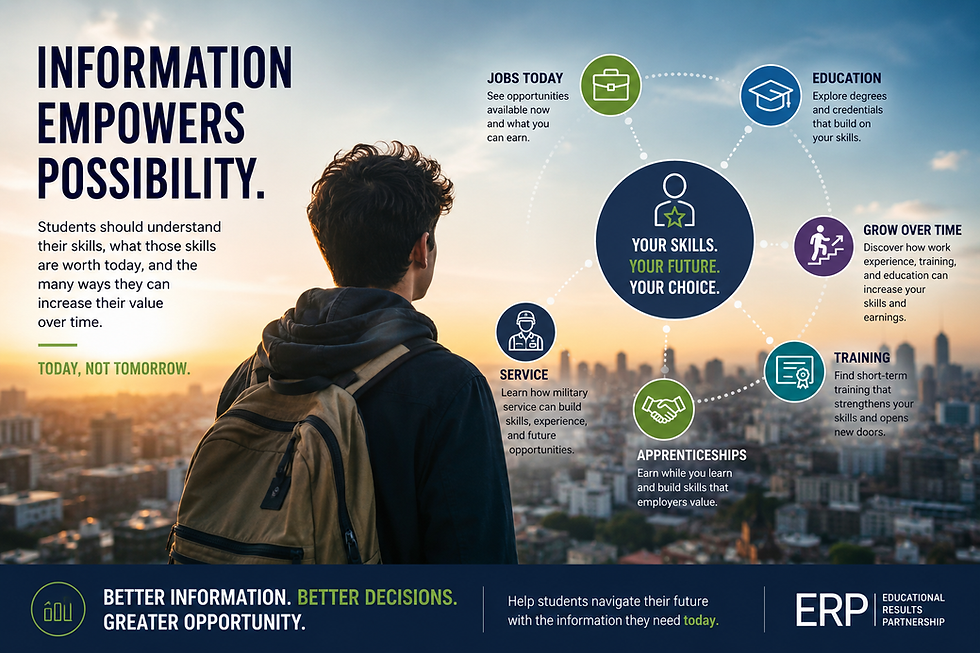
That is why we designed SkillSight to begin somewhere different. Students need career guidance grounded in the skills they have already demonstrated and where those skills are in demand.
Instead of asking students only what they think they might like, SkillSight helps them see what they have already demonstrated they can do. It translates academic evidence—including coursework, grades, state assessment results, and Lexile® and Quantile® measures—into a personalized skills profile. It then connects those demonstrated strengths with occupations where those skills are valuable and in demand.
This is not about telling students what they should become. It is about giving them better information rooted in real data.
A student may discover that the analytical, mathematical, reading, or problem-solving skills they have developed in school align with destination careers they have never heard of. They can explore those occupations, including the wages and education or training required. SkillSight also introduces students to starter jobs they may qualify for with a high school diploma that can help them begin moving toward those destination careers. Students can explore a path, gain experience, and pivot as their interests and skills evolve.
SkillSight gives students a data-informed starting point and helps them see their skills as currency that can grow over time—not as a temporary label based on a momentary preference.
Career relevance should not require another test or program
We also made a deliberate decision about how SkillSight would work for schools.
Educators and administrators are already stretched thin. Initiative fatigue is real in many school districts. Districts are constantly asked to adopt another program, administer another assessment, attend another training, or add another responsibility to an already full day.
Even a promising idea can become a burden when it requires educators to “do one more thing.”
We did not want SkillSight to work that way.
We also did not want cost to become another barrier. That is why SkillSight is available at no cost to California school district administrators and counselors. Districts can use information they already collect to access personalized student skills profiles and career matches—without purchasing another assessment or asking educators to take on another initiative.
California school districts already collect a tremendous amount of information through CALPADS, CAASPP, course grades, and other academic measures. That information is primarily used to document what students have completed and how they have performed.
We saw an opportunity to make that same information more useful and empowering for students.
SkillSight does not require schools to administer a separate skills assessment. Instead, ERP translates information districts already collect into the skills-based language increasingly used by employers. This helps educators communicate the career relevance of what students are learning without changing what they teach.
More importantly, it helps students understand the value of the skills they are developing and learn how to communicate those skills to employers looking for their talent.
The goal is not to add another initiative. It is to unlock more value from the work schools and students are already doing.
Building a bridge between education and employment
Our education system and labor market often speak different languages.
Schools communicate through courses, grades, credits, test scores, and diplomas. Employers increasingly communicate through skills, competencies, and experience. Students are left in the middle, expected to translate one language into the other largely on their own.
Students deserve a bridge.
That is the mission behind SkillSight: to help students understand that their education is building skills with real value—and to show them where those skills are in demand.
This is especially important for students who do not have family connections, professional networks, or adults in their lives who can introduce them to the full range of career possibilities. Skills-based career guidance can help make those possibilities visible.
It can also help employers see talent they might otherwise overlook.
See SkillSight in action on September 10
On Thursday, September 10, at 3:30 p.m. Pacific Time, ERP will host a free webinar for California school districts and others interested in what skills-based career guidance looks like in practice.
We will demonstrate how SkillSight works, share what we learned from our first student pilot with Rowland Unified School District, and explain how other school districts can use the information they already collect to help students understand their skills and explore careers aligned with those strengths.
The early results are encouraging: 83% of participating students said SkillSight helped them better understand their strongest skills, and 82% said it helped them better understand which jobs align with those skills. We will share more about what students told us during the webinar.
If you are a school district leader, counselor, CTE coordinator, funder, policymaker, or education-to-work thought leader, I invite you to join us.
Skills-based hiring is changing how employers identify talent. It is time for students to understand that language before they enter the labor market.
Come see what that could look like.
Register for the free September 10 webinar to see SkillSight in action and learn how your district can get started.
Thursday, September 10, 2026 | 3:30 p.m. PT | Registration Link: https://shorturl.at/Fj1Xz



Comments