
The Future Isn't About Telling Students What To Do
It's about giving them the information to decide for themselves.
By Alex Barrios
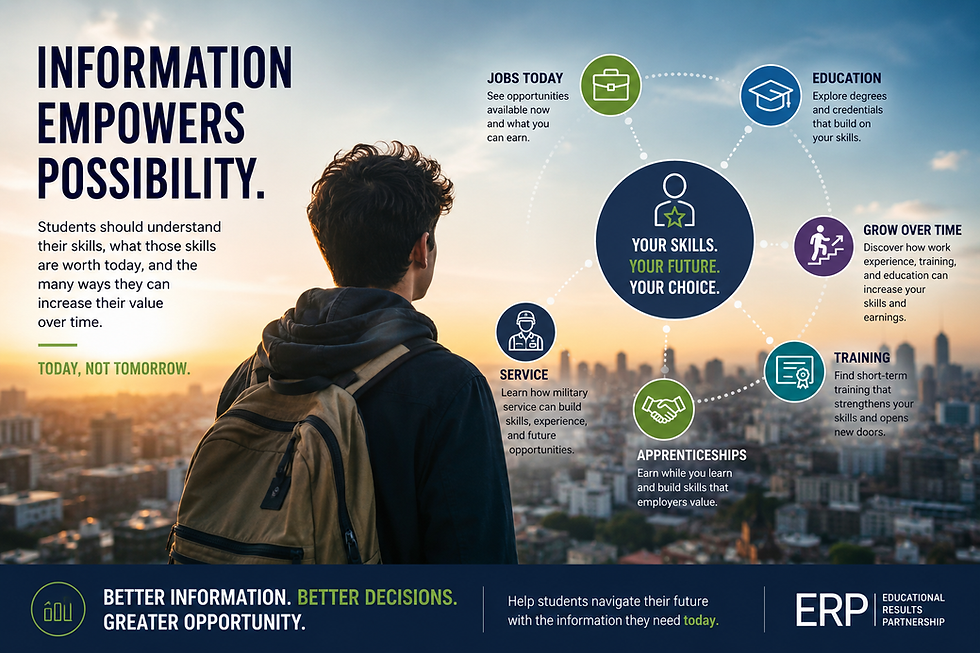
For decades, conversations about preparing young people for life after high school have often focused on pathways. Should students attend college? Pursue career training? Enter the workforce? Join an apprenticeship? Serve in the military?
These questions matter. But they are not the most important questions.
The more important question is whether students have what they need to make informed decisions for themselves, including decisions that can help them meet their immediate financial needs.
Today's students are entering a world that looks very different from the one their parents experienced. Employers are increasingly adopting skills-based hiring practices. Artificial intelligence is rapidly reshaping jobs. New occupations are emerging while others are changing in real time. At the same time, students are being asked to make life-changing decisions about education, training, and careers with surprisingly limited information about one of the most important assets they possess: their skills.
Every year, students leave high school having developed valuable skills through coursework, assessments, projects, and learning experiences. Yet few can clearly articulate those skills, understand how they relate to immediate career opportunities and earnings, or evaluate how different options might help them increase their labor market value.
That is not a student problem. It is an infrastructure problem.
The role of government, organizations, and individuals working to improve education-to-employment outcomes for today's youth should not be to tell students what they should do after graduation. Too often, well-intentioned guidance is based on outdated information or assumptions about a world that has changed dramatically in recent years. When young people hear adults tell them what they should do without acknowledging the realities they are navigating, that guidance can ring hollow.
Instead of telling young people what to do, we should be building valid and reliable infrastructure that gives students better information so they can exercise self-agency and make informed decisions for themselves.
Students should be able to understand the skills they have developed, what those skills are worth in today's labor market, and the opportunities those skills can unlock. They should also be able to see how different experiences—including employment, training, apprenticeships, military service, and higher education—can increase the value of those skills over time. Most importantly, they should be able to do so using information grounded in data rather than assumptions.
For generations, educational attainment has been one of the strongest predictors of economic opportunity. That remains true today. Postsecondary education continues to open doors, expand opportunities, and create pathways to upward mobility for millions of Americans.
What has changed is not the value of education. What has changed is the environment students must navigate and the immediate challenges many students must overcome just to stay afloat.
Today's students face a labor market that is evolving at an unprecedented pace. Employers are placing greater emphasis on skills and work experience. Artificial intelligence is transforming job requirements and creating new occupations while reshaping existing ones. Career pathways are becoming more flexible, more personalized, and less linear than they were a generation ago.
In this environment, success depends not only on access to opportunity, but also on access to real-time information.
Students need better tools to understand the skills they have developed, how those skills connect to opportunities and earnings available today, and how different choices—including work experience, training, apprenticeships, military service, and college—can increase the value of those skills over time.
The question is not which choice is best. The question is whether students have the information necessary to make informed decisions about the choices that are best for them right now.
In many ways, we have already built sophisticated infrastructure to help students understand their academic progress. We know how to measure learning. We know how to report academic achievement. What has been largely missing is infrastructure that helps students understand how the skills they develop through learning connect to the opportunities and earnings that exist beyond school.
As employers continue to place greater emphasis on skills and work experience and as technology continues to transform the labor market, that gap will become increasingly important to address.
These ideas are not merely theoretical. Over the past year, Educational Results Partnership has been exploring how academic performance can be translated into workforce-relevant skills signals that help students better understand their most marketable skills and connect those strengths to opportunities. In our newly released report, Skills Currency: Building a Common Language Between Education and Employment, we share findings from our first student pilot and outline a broader vision for helping students navigate an increasingly skills-driven economy.
Students deserve more than advice. They deserve information.
If we can build systems that help students understand their skills, what those skills are worth, and how they can increase their value over time, we will not be limiting choices. We will be expanding them.
That is the direction we should be moving—not toward telling students what to do, but toward empowering them with the information they need to decide for themselves.
To learn more about ERP's Skills Currency initiative and read the full report, Skills Currency: Building a Common Language Between Education and Employment, visit www.edresults.org.


Comments